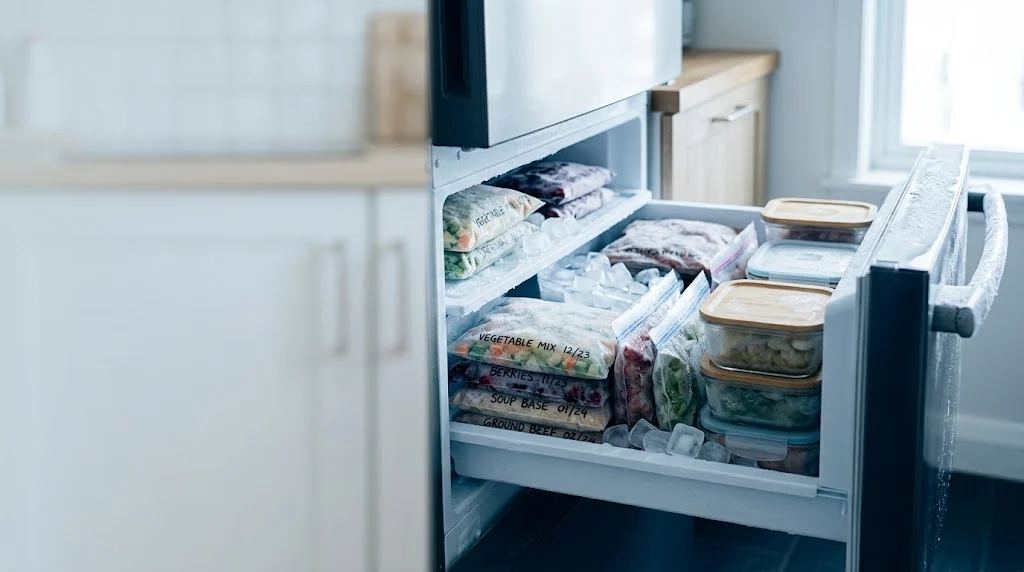
Freezing is the easiest way to stop food waste, but a few small mistakes cause most of the disappointment: freezer burn, mushy vegetables, soups that crack their jars, and meat thawed the unsafe way. These are the rules that fix all of it.
Is frozen food safe?
Yes. According to the USDA, food kept constantly at 0°F (-18°C) stays safe indefinitely, because freezing stops bacteria from growing. What it does not do is kill them, so bacteria that were on the food before it went in become active again once it thaws. That is why how you thaw matters as much as how you freeze.
The storage times you see on this site and on USDA charts are for quality, not safety. Food frozen longer than the recommended time is still safe, but it slowly dries out, loses flavor and can pick up freezer odors.
Set your freezer to 0°F
Most home freezers can hold 0°F, but the dial rarely tells you the real temperature. A cheap freezer thermometer does. Keep it in the middle of the freezer and check it after the door has been closed for a few hours.
- Aim for 0°F (-18°C) or colder.
- Don’t overload the freezer with warm food at once. Add a few containers at a time so the temperature stays low.
- Leave some space between new packages until they are frozen solid, so cold air can reach them.
Package it airtight
Air is the enemy. Freezer burn, the dry, grayish-white patches on frozen food, happens when moisture escapes from the surface and the food is exposed to air. It is safe to eat, but the burned spots are dry and bland, so trim them off before or after cooking.
- Use freezer bags, freezer-safe containers or a vacuum sealer. Thin sandwich bags and ordinary plastic wrap let air through over time.
- Press out as much air as you can before sealing bags. Lay them flat to freeze, then stack them.
- Leave about 1/2 inch of headspace in containers of soup, sauce or other liquids. Liquid expands as it freezes and can crack glass or push lids off.
- Wrap meat from the store in an extra layer (foil, freezer paper or a bag) if you plan to keep it longer than a month or two.
Hear it as a song: Air Is the Enemy, the freezer burn song, a two-minute punk music video about these rules.
Prep before you freeze
A few minutes of prep makes the difference between frozen food you love and frozen food you throw away.
- Blanch most vegetables. A short dip in boiling water, followed by an ice bath, stops the enzymes that make frozen vegetables go dull, tough and off-tasting.
- Flash freeze small pieces. Spread berries, chopped fruit, meatballs or cookie dough on a lined tray, freeze until firm, then bag them. They stay separate, so you can take out just what you need.
- Cool cooked food quickly. Divide large batches into shallow containers so they chill fast, and get leftovers into the fridge or freezer within 2 hours of cooking.
- Portion before freezing. Freeze in the amounts you actually use. Smaller portions also freeze and thaw faster, which is better for texture.
Label and date everything
Every frozen package looks the same after a month. Write what it is, the date, and the amount on every bag or lid. Put new food at the back and move older food to the front so it gets used first.
Thaw it safely
The USDA lists three safe ways to thaw food. Never thaw meat, fish, dairy or cooked food on the counter or in hot water: the outside warms into the danger zone (40-140°F) long before the middle thaws.
- In the fridge. The safest and easiest. Small items thaw overnight; large items like a whole turkey need about 24 hours for every 4 to 5 pounds.
- In cold water. Seal the food in a leak-proof bag and submerge it in cold tap water, changing the water every 30 minutes. Cook it right after it thaws.
- In the microwave. Use the defrost setting and cook the food immediately, since some parts may start to cook.
You can also cook many foods straight from frozen. It takes roughly 50% longer than cooking thawed food.
Can you refreeze it?
Food thawed in the refrigerator can be refrozen without cooking, although it may lose some quality from the second freeze. Food thawed in cold water or in the microwave should be cooked before refreezing. Raw food that was frozen, thawed and then cooked can be frozen again as a cooked dish.
See the full refreezing guide and food-by-food chart.
Foods that don’t freeze well
Almost everything can be frozen safely, but some foods come out badly:
- Eggs in the shell expand and crack. Beat them first, or freeze whites and yolks separately.
- Watery raw produce such as lettuce, cucumbers and radishes goes limp and soggy.
- Mayonnaise, cream sauces and custards tend to separate.
- Cooked egg whites turn rubbery.
- Fried food loses its crunch unless you reheat it in an oven or air fryer.
- Unopened cans and sealed carbonated drinks can bulge or burst.
Not sure about a specific food? Ask us and get a straight answer.
How long food keeps frozen
Best-quality times at 0°F, based on USDA guidance. Food stays safe longer; it just slowly loses quality.
| Food | Best quality for |
|---|---|
| Bacon | 1 month |
| Sausage (raw) | 1-2 months |
| Hot dogs and lunch meat | 1-2 months |
| Ground meat (raw) | 3-4 months |
| Steaks (raw) | 4-12 months |
| Chops and roasts (raw) | 4-12 months |
| Whole chicken or turkey (raw) | 1 year |
| Chicken or turkey pieces (raw) | 9 months |
| Cooked meat and poultry | 2-6 months |
| Soups and stews | 2-3 months |
| Casseroles and leftovers | 2-3 months |
| Raw egg whites or yolks | 12 months |
For a specific food, search it above. Every answer page lists its own freezer time.
If the power goes out
Keep the freezer door closed. A full freezer holds its temperature for about 48 hours, a half-full one for about 24 hours. Food that still has ice crystals or is at 40°F or below can be refrozen or cooked. When in doubt, throw it out.
Sources: USDA FSIS, Freezing and Food Safety; FoodSafety.gov, Cold Food Storage Chart.